Showing posts with label electronic books. Show all posts

Saturday, June 3, 2017

An Alarming Reading Trend


I’m worried.


I don’t want to be, but I am. 

Partly, this is the fault of who I am. I tend more towards the cautious side. Partly, this is the fault of cold pitiless numbers. In this instance, there are specific numbers to which I refer.

 9,000
 11,000
 9,700

 8,000
 6,000

See what I mean? Ah no. Wait. It’s unlikely you do for I haven’t put them into any context. Here’s how I should have posted them.

Physical books checked out of our school library. (Numbers are rounded.)

4 years ago: 9,000
3 years ago: 11,000
2 years ago: 9,700

1 year ago: 8,000
Current year: 6,000

Have these numbers tickled your curious side? Or, like me, do they skip the curiosity phase and go straight to alarming you?

Not alarmed? Eh, interesting. 

Is it because you noticed the use of the words “physical books” to describe the circulation numbers and figure the picture isn’t complete because our school provides electronic versions of books to be checked out by students? Well, you get a gold star for noticing. We do indeed provide electronic copies to our students. 

Here is the rounded number for electronic copies checked out this school year: 1,800.

Using a high-powered calculator, we come to an adjusted number for this school year of 7,800. The revised list should look like this. [NOTE: I did not pull the number of electronic copies for any previous years as this is a relatively new offering for our students.]

4 years ago: 9,000
3 years ago: 11,000
2 years ago: 9,700

1 year ago: 8,000
Current year: 7,800

On the surface, 7,800 doesn’t appear all too bad. It reflects a small drop-off from the previous year, at the very least and maybe reflects the adjustment phase as we transfer over from physical to electronic reading. But that’s the problem with surfaces, they too often hide a reality beneath them; and, in this case, we’re talking about the difference between solid oak and oak veneer.

Students checked out 1,800 electronic books this year. It seems solid. Seems

Our electronic book library come with a nifty computer program that lets us see a whole swath of things: who checked out what, which books are most popular in a month, how many minutes a student spent with a book open, how many pages they viewed, and so on, and on, and on. 

The program allowed me to ballpark how many of those 1,800 checked out books were actual titles checked out versus those which were the same title checked out by the same students over several periods. The new number drops closer to 730. A big difference. 

Of those 730 or so actual checked out titles, it appears as if only 40-50 were read in full. That’s the data I care about; the data I worry about.

Of the 1,800 books checked out, only 40-50 of them show as having been read in full. And, this is with me being rather lenient and giving credit for books close to done because I don’t know how many blank, filler, author biography, first chapters of other books, etc. are along with a title. Another wrinkle is that swiping through pages and/or skipping to the end of a digital copy registers as completed in the computer program. We do have the ability to see minutes read and could try and match those to pages read, but that’s a task I’m unwilling to tackle this Saturday morning. Suffice it to write, 40-50 may not even be a true picture of what was read electronically. The same principal applies to the physical books too. Just because they were checked out doesn’t mean they were read in full. 

If that caveat isn’t enough to question the solidity of that number, then consider that a large number of these “read” books were checked out for books clubs or whole class activities and were what I think of as forced checkouts: they were for class, not for idle enjoyment. The same applies to the physical copies that left the library. Many were for book club or whole class assignments and not necessarily for enjoyment reading. This stipulation applies to any previous year too, of course, which does nothing to change the trend. It’s moving down, not up.

Because I can only conjecture on who actually read what was checked out, I won’t lower that 4-50 total. However, it is one to be taken very lightly at best. Here’s the revised total for the current school year.

Current year: 6,050

Not as hopeful. 

It did manage to get the physical circulation numbers for the grade above ours, grade 7, for the last two years. Here are those.

2015-2016 school year 5,500 books circulated.
2016-2017 school year 4,000 books circulated.

Another drop off. Yes, the middle school offers electronic books too, but I do not have those numbers. Again, I can only conjecture, but I’d go with the same scenario as our own building and assume it’s a much smaller number than the physical totals and one that can be taken with a grain of salt.

A-LAR-MING!

The big question is why is the trend going the wrong way?

It’s not at all as if we’ve suddenly changed our teaching style, goals, or enthusiasm for reading. Education rarely changes quickly and a love of reading would be the last thing to leave or bones. No, we remain a department of eight Language Arts teacher and one curmudgeonly skeptical reading teacher, employing a Reader’s and Writer’s workshop model, who love our books. Love them!

Maybe there’s been personnel change? Yes, there’s been some turnover in personnel but not much. Insignificant. The district, school, and individual goals all remain the same: we want to foster natural readers and writers.

Can’t lay blame on our administration or librarians because they’re the same people who were with us over the last five years. They’ve been as supportive emotionally, professionally, and financially as anyone can expect.

What’s changed?

Well, this is where it all gets messy. Messy as heck, because who knows exactly? 

Possibly, students are buying more books at home, using the town library more, or passing on books they’re not likely to read again. Not that’d I wager on any of those instances as being the primary issues. Home life continues to evolve. We know many of our students have robust after-school lives, but that’s been true for many, many years. Home electronics present another possibility to why reading seems to be eroding, despite our efforts. There too, I wonder. Game systems, iPads, laptops, and personal phones have been in our community’s hands for years now. 

Though I may well be pilloried for this, I can really only point to one big change in our classrooms; and that is the introduction of iPads. We have had one-to-one (one iPad for each student) access for several years now at various grade levels, working from our high school down. This year was only our first year with each student having his or her own iPad for use throughout the school day. We did have them in sets for teams to access, but they were shared and not carried around all day by the students. The HS, depending on the grade level, has had them for 4 years now and some elementary grade levels for a year or two. Middle school has had them for 2-3, I believe.  In other words, there is some verifiable overlap between these devices and the circulation timeline presented in this article.

I know, I know. They’re a tool and not going anywhere anytime soon. Got it. And yes, every teacher set the tone for these tools. You can ask every student who enters your room to put them away to work with physical paper if you like. This does happen. It just...feels like a harder stance to maintain.

I’m not looking to debate the good or bad of the device. It does have some amazing capabilities and has allowed our students to do some terrific things because of them. It’s just that the downside, in this reading teacher’s opinion, is concerning. There’s no longer a barrier or distinction between home behaviors with devices and school behaviors because they're now ever present. The phone or iPad at home is for games, texting, researching, and reacting to it every time it chimes. While we watch strictly how students use them in school, their belief is that what they do at home is how to use them in school, and how to react to them in school. The iPad is sometimes more authoritative and commanding of attention than the teacher in the room. Think about that. If you doubt this, then think about that the next time you’re speaking with someone, your phone chimes, and you reach for it without thinking. 

Anyone who’s used an iPad for his or her reading knows the pitfalls. It truly is a challenge to remain lost in a book. Notifications intrude often and if there’s a moment of weakness while reading it becomes all too easy to decide to just “check on something”: email, FB, some Amazon product, etc.

This is not to blame the students. I’m no better at home sometimes, which is why I’ve moved back to physical copies of books exclusively the last two years. I can’t trust myself on an iPad to remain focused, to read and think deeply. 

Our response to this next year, as a department, will be an increase in sustained reading within the school day. We’re also planning to offer book-swaps and increased time for students to spend time investigating new, physical, copies of books.

Who knows, we may even have to explore the mindfulness of reading, the mental value that comes from focused, meditative-like engagement with a text.

Oh and please, before anyone tells me how people and kids are reading more than ever because of how much time they spend on their devices visiting sites and working on things, let me chuckle right now. 

It’s not true in my eyes and that’s for two reasons. One, I’m a self-admitted curmudgeon and skeptic. I say nay to things first and wait for proof to be convinced otherwise. Two, there’s a vast difference between glazing over swaths of words and actual, deep, even meditative, reading of words. It’s like saying that because kids are texting thousands of words a day, they’re writing more than ever. Nope, not sold. Besides, the trend appears to be moving to emojis only. Though I won’t use them (still -proudly- don’t own a phone), if I had to this article would end with a thumbs down, worried face, and giant question mark set of signs.

Sunday, November 6, 2011

No Power in CT but Loads of Electric Moments

Maybe I'm ready to retire from reality, because this posting somehow manages to tie together a novel reading experience with the Great Pumpkin Storm of 2011.

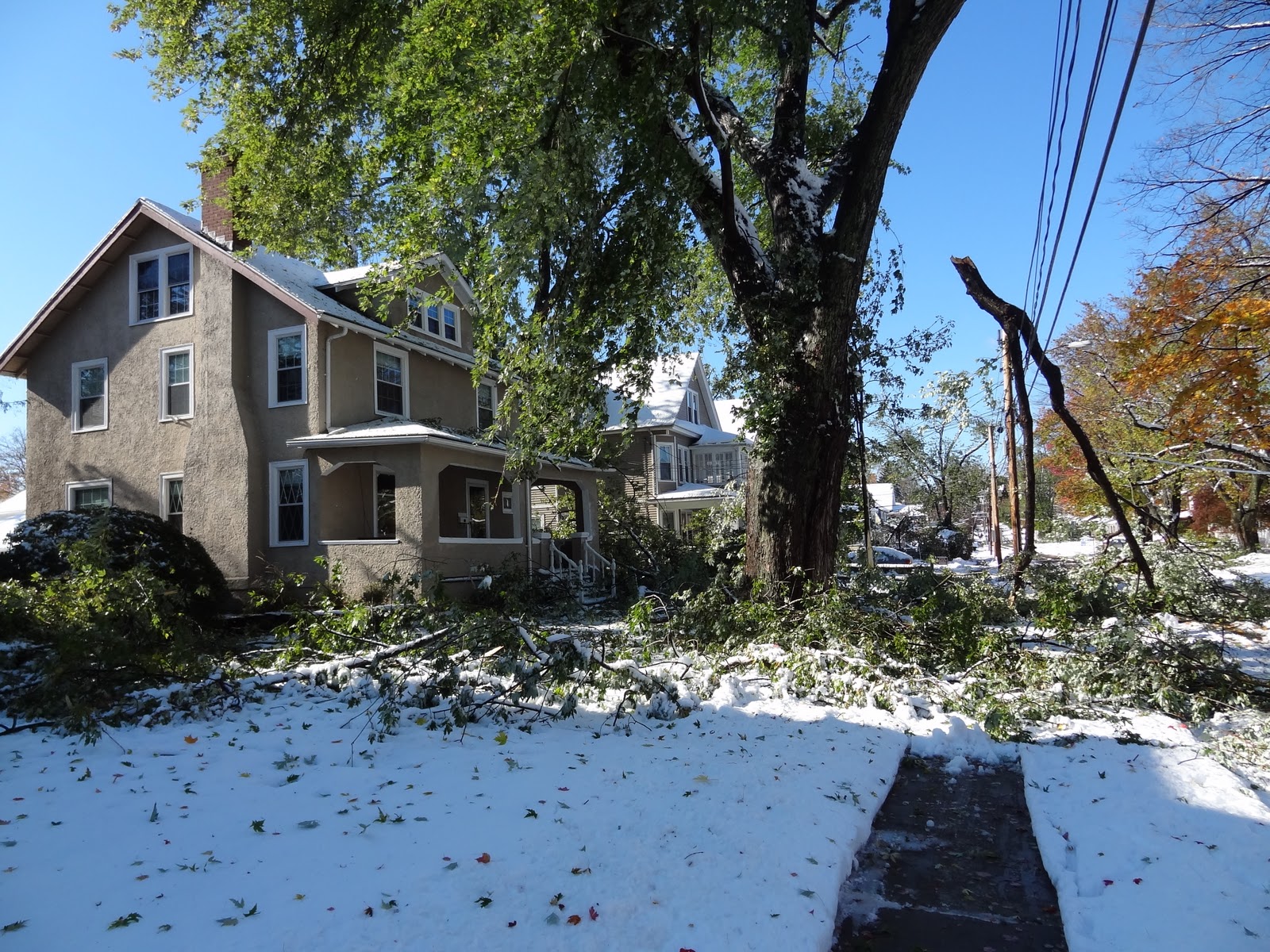
Like so many families in Connecticut, I found myself up most of last Saturday night into Sunday morning, held hostage by the periodic sounds of loud cracking followed by thunderous BOOMS as limb after limb crashed around my property. My family and I went 5 days without precious electricity and despite the loss of power, I had a ball. It wasn't all perfect by any means, but it wasn't terrible -not even close. I saw and got to be a part of many small and sizable gestures of kindness. I also got to experience a new form of reading.

But first, a small side-trek into how our family got through the storm and its aftermath.

Somewhere under the greenery and limbs is my home.
There was something very pleasing, to this guy at least, with having to confront the moment at hand and not worry about work schedules, traffic, the kids' soccer games, and other modern obligations. Without power, we had to scramble for heat, lighting, and preservation of food. We packed items in coolers using the snow, relied on a Napoleon stove and our fireplace for heating and cooking, and used a mish-mosh of candles and rechargeable lanterns for lighting. I love challenges like these. We lost very little food and managed to eat some great meals cooked by grill, heating stove, and fireplace during the week. We're still talking about the potatoes baked in the coals of the fire Our family of five, spent nights on the main floor tending to things, staying warm, and mostly getting along. We even told spooky stories on Halloween. 

It took 3 days to clear all the debris about the house and this happened with the help of our kindly, chainsaw-wielding neighbors. (In my dreams, the neighbors usually chase me with these, but this past week they seemed content focusing their attacks on the downed limbs.) My family and I returned the favor to others when we could and most days flew by as each task needing doing got done.

Survival moments aside, there were opportunities to read and see books, because part of most days were spent walking to Barnes and Noble in town. The primary goal was to recharge our electrical items. The second goal soon became one of sharing stories with neighbors and friends, who happened into the store for similar reasons. When those two missions were finished I was freed to explore books. Trapped in a bookstore for a week? That's the stuff of dreams for a reading teacher! While I perused many books, one experience really floored me.

We'd dragged our laptops, iTouches, Kindles, and iPad to the store planning to take advantage of the free Wi-Fi. At one point, when I was tired of roaming and chatting I decided to see what free reading materials I could pull down onto our iPad. I've loved stories told with pictures since I was a child and soon found myself exploring a site that offers loads of free comics. The comics on this site are specifically fitted to an iPad window and look great.

Zeroed in on one part of a full panel.
Now, if all the website/app did was display hi-resolution images of individual comic pages, I'd still enjoy it but would hardly have felt compelled to share the experience. Where things changed for me was when it was suggested by the app that I double-tap an individual frame on the comic book page. 

Doing this proved eye-opening. 

I sat stunned as the rest of the page disappeared and -like a camera zeroing in on one face in a crowd- the single panel of art and words became the focus. Incredible! 

I can sometimes turn to skimming when I read a lot in one sitting. Comic books are especially easy to do this with. I focus on the words but use the images to skip along at points. This new format of delivery the story stopped all that, instantly. I was memorized and spent extra time and attention on the word flow and artwork. I should probably add that it made me feel like a kid again.
a less dynamic full page of art and story

It's difficult to explain, in print, how dramatic an effect this had on reading the story. The best I can offer as comparison is to think of any news/magazine or documentary show on TV you've watched where still photos are shown very close to the screen and a camera pans slowly to different parts of it as narration unfolds. That was how this went on the iPad each time I read, then tapped, a panel. And, the camera movement wasn't always simply from one panel to the next. Sometimes the top of a large panel was the focus then -tap- the bottom of the same panel was panned to. Or, a small section of a character's face would be the lone focus before panning back to reveal the entire face and body. In one instance, the speed at which the panning happened was accelerated to underscore the moment a punch landed. 

So, for this slightly daft Nutmegger- the Great Pumpkin Storm was one I'll look back at fondly.

If you own an iPad, and are even vaguely interested in experiencing this reading approach for yourself, then head over to ComiXology, download the app, and explore some free comics.


Sunday, February 13, 2011

Kindles Can Do

     After a period of considering and testing several other portable reading platforms, I ended up exactly where I had originally planned when applying for a grant to fund eReaders for my young readers. After buying and trying the Nook, the result is we've become a Kindle-toting classroom.
     After the perfunctory introduction to all the little buttons and tasks a Kindle can perform, the students have settled into reading from them as they would any other print -albeit with a few positive wrinkles.

* We all have a voice: Kindles offer a voice-assisted reading program, which when activated  translates displayed text into audio. Several students make regular use of this feature and appear to enjoy it. Personally, I find the computer-assisted reading feature off-putting, but that's me.
* Swiss-knife eReading: Many students have been interacting well with their Kindles by making use of the ever-present dictionary. When they discover a word that confuses them during read, they can move a cursor to a spot just before the word and then glance to the bottom of the viewing window. There they will find a suggested word meaning in a slim pop-up window. This is one of the least intrusive ways I've seen for learning about challenging word and I like it a lot. The Kindle is like a Swiss-knife reading unit in this way because it has all you need, and more, packed into a portable package.
* Chocolate Sampler: The students have explored almost 25 books in only a few classes using their Kindles. The ability to download a sample for almost any new book has been awesome, because while my room is filled with books, which students can easily examine, I couldn't possibly fund bringing in all the latest books for review. The Kindle can and, unlike a laptop, presents all of this in one easy-to-survey glance. Students have poked their minds into many books samples to date such as Woods Runner by Gary Paulsen, Models Don't Eat Chocolate Cookies by Erin Dionne, and Sharks by Peter Benchley -none of which I have in my room in hard copy. Of these three titles, I've ordered the latter two because interest in them has been significant. Sadly, and maybe only for the moment, Paulsen's Woods Runner is not in demand. His book, apparently, is the butter creme of the bunch for this discerning group of readers.
* Making the Most Cents: Another powerful aspect of having Kindles has been the number of copies I have been able to bring into it with a simple click of a button. When I noticed the book Boost was a hit with students in other classrooms, I made that my first Kindle purchase. It cost 9.99, which seems fair, at first, and then quickly became a steal of a deal when I transferred 5 more copies of the book at no additional cost to four other Kindles. (Most ebooks allow for 5-10 copies to be used at a time from one an account.) So, the real math worked out to less that two bucks a book, which makes the most (sorry) cents to anyone running a classroom and promoting reading. I now have about half my students reading Boost and being in a position to share their reading experience. Thus, for 10 bucks I have 5 happy readers. Excellent stuff!

     It's not all been perfect in this early going. Because I have ebooks spread unequally across several Kindles and far more students than Kindles, I've had to track which person is reading from which Kindle. Then everyone has had to learn the art of recording a location number to find their place for when they return to their book a few days later. Also, while the American and Oxford dictionaries are excellent sources for finding definitions, many continue to be too difficult for the younger audience. I wish there was an intermediate version available for installation. I'd happily pay for those to be on each Kindle. Still, these are minor nuisances when compared to how well they're enjoyed in the classroom.

     Maybe your child has come home asking about one already? I will say that -if you can swing it financially- it worth buying one. And, there's a chance Kindles will drop to 99 dollars by the summer as that seems to be a good price point to sell even more. 


Saturday, April 17, 2010

School Libraries: The Blockbuster of Today?

     To begin, I love libraries and book stores. Well, to be more specific, I love what's in them. When I tell my family that I'm going to stop in at Barnes & Nobles, Borders, or the library in town, they understand that this means several things at once:
  • I'll be out of touch for at least two hours. (I don't own a cell phone and even if I did I wouldn't bring it with me.)
  • If they want to tag along, they have to decide if they can handle the minimum two hour visit time as well as put up with my many single syllable responses to their queries. 
  • I'm going to put a nifty little dent in the family bank account.
  • More books will be have to be squeezed into already tightly-packed bookcases.
     The thing of it is, I'm beginning to wonder how much longer the brick and mortar homes of books can remain as they are. I'm wondering if I need to make those trips by car and foot to my mecca. Just consider the Blockbuster versus Netflix business models and you'll understand what I mean. 
     Netflix has mortally wounded Blockbuster with its mailbox DVDs and online streaming. We want what we want quicker, cheaper, and delivered directly to us. Going to a store or the library simply doesn't hit on all three of those needs. Thus is Netflix able to slay a company many thought would replace the theater business, which is actually being handled by today's home entertainment theaters. These dynamic changes have me musing about school libraries. 
     Our school libraries, if they were a business, are far closer to Blockbuster than Netflix, and this is worrisome. In a business like Blockbuster, movies are bought, delivered, repackaged, cataloged, and shelved for customers take home. You could substitute books for movies and students for customers and still be accurate about the school library model. In both instances, there is a of time and expense woven into the goal of having individuals come, peruse, and leave with products in hand. It's a centralized model, which has Blockbuster scrambling to be more like Netflix and it's push out ways.
     I wonder if the time hasn't come to work more on a push out model for our business...err...libraries. I'm not calling for an end to physical books, or even librarians, but any means. In fact, both remain indispensable to education.  No, what I am suggesting is recognizing the successful models of today, our customer wants, and mimicking them as best as we can. This means divvying library books into classroom sets and adopting eReaders as soon as possible. That's right. Don't put the books into one big room, put the books into all the little rooms where the students are. And, start transitioning to the medium most are using now, electronic delivery of information.

Consider  all of these statements:  

  • Every generation, from this point on, carries more computing power in their mobile devices than NASA had when launching the first ships to the moon.
  • Electronic books are cheaper than paper books.
  • When given the choice between going to the library to check out a book or downloading it to a portable reading device, most will overwhelmingly chose the second option.
  • Locating the right read is easier and quicker (even more enjoyable) using Amazon (or our Destiny Quest browser) than working your way through rows and stacks of books. (Okay, I'll admit. I do like the experience of discovering a book by randomly roaming up and down the aisles, but I believe I'm in the minority with this one.)
  • The Kindle, Nook, and Sony eReader can hold thousands of electronic books either via purchase or free download from the thousands of books in the public domain. (Wait until Google enters the field!) A lot less physical space is necessary.
  • At least one state, Utah, has adopted eReaders as the primary means by which textbooks and pleasure books will be put into student hands. Texas is also heading in the same direction. (The larger sized Kindle displays entire textbooks with perfect clarity and all the usual instant connections to links, videos, updated information, etc.)
  • Items stacked next to store registers tend to sell quickly, the so-called impulse purchase. Books, when well displayed (covers showing, not spines) tend to be checked out most frequently. Put 50 books on display in every classroom and they'll start moving. 
  • Most eReaders allow users to read the first chapters of new books for free. They also show users books most-like the ones being read or examined. 
  • Student connections between subject matter (science, social studies, art, etc.) can be enhanced through the proper pairing of classrooms to teachers and students.
The push out concept is not a silver bullet. There are complications. Tracking books from classroom libraries is much more challenging and potentially onerous for teachers. Librarians must make more trips to classrooms to share books and swap new titles for older titles.  However, this is how major transitions tend to work. It's not without bumps. Netflix began with DVDs to mailboxes only, then limited streaming, and slowly is working toward complete streaming. 
     Librarians, take heed. While I'm confident, as a mere reading teacher, that I misunderstand much of how a library functions, I feel as confident that change is coming and should be embraced. So, for those working the stacks, I welcome any comments you may have.

Friday, January 22, 2010

Hard (Copy) Decision


The question isn’t will I, it’s when will I. When will I switch from purchasing, carrying, and peering into hard copies of the written word and embrace the soothing, high-resolution, electronic delivery of the written word, because the next step in delivering the written word to each of us is in mid-stride.


Kindle is leading the way, followed by eReader, and now the Nook. Each device is portable and capable of delivering a massive number of books, articles, and blogs to your fingertips. Anyone who says this won’t replace books did not pay attention to events in the music world.

The iPod came, it saw, it conquered. Vinyl recordings are a clear marker in my life of how old I am these days, and I don’t sound all that hip and relevant when I mention music CDs either. (Hmmm… add the word hip to the list of you’re-showing-your-age items.)

I do love books. I find it incredibly relaxing to peruse books in a library, store, and even online. I like holding books and being an owner of books. My home is in many ways a small library unto itself because of how much I enjoy books. And yet, this does not mean I won’t eventually change how I receive the written word of others.

Frankly, there’s too much to like about the new age of print to stay away from it much longer. The real difficulty is going to be deciding which portable device I finally purchase. There are pros and cons to each device, which I will not bother with here as there are hundreds of sites that have done this already. Instead I’ll give my reasons to go electronic along with my worries.


The reasons to buy electronic:

It is cheaper. Yes, the machine costs money, but the savings with electronic version of books makes up for it. Hard copies of books cost far more and take longer to come down in price. Electronic books begin cheaper and move down in price quicker than those we purchase from a brick and mortar locale. There is less clutter. Books pile up quickly, and they have an eerily magnetic way about them when it comes to dust. A thousand books on shelves is messy. A thousand books in electronic form is sublime. I will make better decisions. I don’t always leave a store with the books I planned to purchase. Sometimes it’s due to cost and other times it’s spotting something else of interest. By accessing Amazon, for example, directly from Kindle, I can see reviews of books and similar types of books to assist with my decisions. There should be less guess work. I’m also often under a time constraint when I’m at a bookstore and make hasty decisions. I’m hopeful there’ll be better organization. My books are sometimes filled with ear-marked pages, highlights, odd slips of papers, or a notation along the inside covers. All of which seem like good ideas until I need to actually return to this information. Then, I’m left wondering what my grand organizational plan was at the time as I look through shelves of books. An electronic device will force me into one method, which is (I hope) much easier, reliable, and sensible.


The reasons I worry about going electronic:


Foremost in my mind is ownership. When I buy a book I can do with it what I will -not so with an electronic version. I cannot readily hand off the copy to a friend. Some electronic readers will allow you the chance to lend a book for two weeks, like a library, but that’s not good enough. Generally, when I lend a book, I don’t expect it back because I know it’ll be gone for months. I worry about instantaneous collection loss. What happens if my portable device breaks? A broken device means I’ll have nothing to read until it’s replaced or repaired. Amazon claims to backup all your purchases, but I’ve read mixed reviews on this. Example, periodicals are only backed-up for two weeks! Normally, I try to weed out piles of magazines. But, if I can have an electronic copy, I would not have to decide what to throw away. I like seeing books. Books packed into shelves simply sings to me. They don’t even have to be my books or books I’ve read.

Most likely, I'll find myself holding onto both in the end. I'm looking forward to the new experience.