Showing posts with label comics. Show all posts

Friday, December 6, 2013

Dogs of War Has a Home in Middle School Classrooms

Dogs of War Makes for Terrific Reading


A colleague, well aware of my affinity for graphic novels, made sure to hand off to me a copy of Dogs of War by Shiela Keenan and Nathan Fox, as well as, a copy of Romeo & Juliet by Gareth Hinds. As of this moment, I doth not have anything to scribe about the latter, not having read it… just yet. For the former, I doth have plenty to scribe about.

Dogs of War is comprised of three short stories, each depicting the role one canine has played in one of three wars –WW I, WW II, and Vietnam. Although the stories are named after each of the dogs (Boots, Loki, and Sheba), and this leads you to believe you’ll be following closely their stories, the canines generally share the spotlight with their various human protagonists. Some might be upset to going into the work to find out the dogs aren’t the main thrust of the book. For me, that hardly mattered. I found the storytelling for all three tales to be brisk, informative, and interesting throughout.

In “Boots”, the first story set in WWII, readers are thrown into the harrowing experiences of trench warfare as viewed through the eyes of a 16-year-old soldier and his loyal dog. Floods, mud, cold, poor nutrition, and bullets –Oh, there are bullets!- fill the story panels as a 16-year-old Donnie and his mates work to hold to a bloodied length of land and survive their terrible battle against the Germans.

If this were all the story had to offer, I’d be hard pressed to find the motivation to write about it here. Where the story develops into something worth sharing with you and (hopefully) with students is in the author’s attention to historical details.

When our human protagonist, Donnie, and his canine, Boots, first find their newest trench allies, the soldiers are, almost pleasantly, trading hot bullets with the Germans over walls of sandbags. Young Donnie is surprised by this but told it’s merely “the morning hate”, whereby each side essentially recognizes that what transpires between them is a common morning occurrence –as if to say, Oh this shooting at each other is nothing to worry about. This seemingly misplaced attitude amid battle is actually –to borrow from our British friends- spot on. Many a soldier who returned from WWI reported as much. I read that some soldiers referred to the morning volley of bullets as “trading tea”, a cute moniker for a dangerous practice. But, the pithy remark underscores something about the sensibilities of the time. Soldiers, on both sides, still held to a sense of nobility in fighting a war, a sense of gentlemanliness. Even if they were trying to knock one another off.

Not wanting to give away too much, I’ll add that "Boots" presents an account of WWI that any middle school student would find highly interesting. Heck, I’m middle-aged and loved seeing the brief scene in which a soldier is cooking up some juicy lice he’s plucked from his uniform.  It’s a story sure to spur discussion about what war, life, and attitudes were like in the early 1900’s; and that can only be a good thing for those of us trying to feed youthful mind.

The other two stories in the collection are equally accurate in their depiction of how men and animals behaved in their respective wars. I was particularly appreciative of the author’s decision to not simply turn these stories into Disney-esque accounts of dogs at war. In fact, although the dogs are presented as the heroes to the stories, they’re really closer to secondary characters, the human protagonists being far better fleshed out for readers. Again, the cause seemed to be to show war as it actually was without making it inaccessible to middle school students. It was also to show how dogs have served our soldiers for a century and more.


Keenan’s and Fox’s story is worthy of classroom use. A halfway decent teacher (and I think I juuuust make that cut) can use the interest it garners to spin students off into further reading exploration about war, dogs, the 1900’s, the 70’s, and much more. I’m already thinking this book will be a fine companion piece to Cynthia Kadohata’s novel Cracker! The Best Dog in Vietnam, a historical fiction book about a dog and his handler helping men survive during the Vietnam War.

Monday, June 11, 2012

Digital Comics

I've touched on the subject of digital comics before noting how much I enjoyed reading them from my iPad. (comics on the iPad) I still enjoy reading comics this way, but this time I'm sharing my low-budget opinion on print versus digital costs when it comes to comic books.

Those of us who are older may recall that comic books once sold for well under a dollar. 25, 50 or even 75 cents an issue held strong for years. Today comics cost anywhere from 2.99 to 3.99 for a single issue, with most really falling under the 3.99 price tag. This is happening for a variety of reasons: paper and color costs are up, better pay is going to talented writers and artists, and the need to feed the shareholder demand for profits is never ending.

Caught in the crossfire are those of us who actually want to read the comics, and many others who want to own physical copies of these items. But the writing is on the wall for tangible editions which are likely to disappear because digital dissemination of comic books is faster, cheaper, and leading to even greater control for the companies that issue them. One would think that the price for digital content, which has no future value at all, would be reasonable. Right now, "reasonable" only applies what you buy and when you buy it.

Like Apple with its music and Amazon with its books, comics cost more the more recently they've been released. A digital copy of the Avengers, for example, runs the exact same price as the physical copy when issued, 3.99. That's too steep for a product that has no long term value. With time, the pricing does seem to drop to 2.99, 1.99, and in some cases .99. But, there's no guarantee that title prices will drop and it can mean waiting a few years for prices to reach the .99 marker. Each Monday, Marvel comics advertises it's 99 cents sale through Comixology. (See image on the right.) This Monday, there were 50 Spider-Man comics for sale at .99 cents each. But these issues date back to 2008. To my thinking, this pricing model wrongs its customers and is going to harm the companies continuing to use it.

Companies like Marvel and DC, the two biggest comic book publishers, should pass on some of the colossal savings they're getting by selling on a digital platform to their customers. Digital sales means less spent on paper and ink, less on distribution to stores and comic specialty shops, and less on guessing how many copies to print in anticipation of demand. These are significant costs for these companies, and POOF! they're gone when your product becomes digital. Still, these companies insist on receiving the same price as the physical edition. That's a mistake. Yes, I get that there are other elements to think of such as the losses coming from the dark practices of those who pirate, losses that occur in trying to maintain a physical presence when moving to a digital one, and the fact that no one is obliged to buy the content to begin with. But, if these companies want to build a following -critical to their financial survival- they'll stop stepping into the realm of gouging. Even now, those who place advance orders of physical comic books receive steep discounts from on-line sites. These range from 25-40% off the listed cover price. And yet, Marvel and DC won't offer the same with digital content. Well, unless you're willing to wait years for prices to drop. Again, that's a mistake and hurts those on both ends of the transaction. They believe they can afford to gouge now because they're profiting handsomely, but that's short term thinking.

The trend to offer digital content cheaply, but in volume, is what's going to bring most comic publishers to a fairer price point. Digital copies should range from 1.99 to .99, with the majority coming in at .99. What Marvel and DC might soon discover is that people will likely try more comic book titles and end up coming back each month to spend the same amount if they figure each one it less than a buck. Right now anyone new to comics is likely looking at 3.99 for one comic book -something that can be read in 10-20 minutes- and thinking, I'll spend my money on something else.

I do believe that eventually comic companies will get this right. Prices will race to the bottom as more independents enter the fray and offer extremely reasonable prices. One talented duo, Zander Cannon and Kevin Cannon of Double Barrel  just released 122 digital pages of their comic for 1.99 through Top Shelf -a very fair price and a heck of a smart move. I bought a copy, and I am pleased I did.

For now, the digital comic book world is out of whack. It will, I hope, get it's collective act together and bring to readers of all ages its fine products at a reasonable (and still profitable) price.

There are a long list of comic book apps to choose from. Some are quite specific, Marvel and DC have their own, but the one I find most seamless and offers the largest variety is Comixology. 


Friday, April 6, 2012

Why Graphic Novels Belong in Classrooms

From Amelia Earhart: This Broad Ocean
     As is practically always my way, I'm going to start off somewhere close to my mark before -eventually- getting to my mark.If you want to skip the preamble, read the bolded font paragraphs.
     There are many reasons which help to explain why watching something on TV or YouTube is chosen over reading. Among the more salient, I feel, is that watching is far less taxing on our focus than gathering meaning from long strings of words. Why try to wrestle with an author's words and conjure up a shared image of a field of wheat or heated argument between two characters, when moving images on a screen can quickly and easily do this for us?
     I get that.
     We all get that.
     And this is precisely the reason why graphic novels have a place in classrooms.
    
     I take great care to explain to my students how I believe graphic novels differ from TV and comic books.Comics are generally serialized and have no expected end. Comic book themes  tend to travel in similar circles -good beats bad, crime doesn't pay, and so forth. I inform my students that a graphic novel for the classroom is different from this, with all due respect to the noble efforts of Superman and Spider-Man.(* See my comics note below.)
     In class, I begin by harping on the second word, novel. Time is spent discussing the word novel, a surprisingly slippery word to pin down.  The general understanding we end up with is that a novel is a complete story which aims to deliver a thoughtful message and/or theme. A graphic novel is essentially just that, a novel. I show them several books we've read and point out that both graphic novels and novels have words of narration and dialogue. The graphic novel just happens to have a lot of carefully created art to go with it.  On the subject of graphics, we don't work from a definition so much as from some central questions: How does the artwork support the events or text? Why have these color tones been selected? Why has the artist broken down this scene into so many (or so few) panels? These work-in-progress definitions, genre attributes if you will, for the graphic novel form are important to our studies and discussions. Students can then put aside any misgivings or preconceived notions they hold about graphic novels and focus on reading for meaning -as well as enjoying some great stories.
     So, where's the support for graphic novels belonging in a classroom? Why, the next paragraph of course.
Harry Houdini: The Handcuff King
   
     Reading is a complex activity at any age. For young adults it's less about decoding the words and far more about making deeper meaning and connections; still no less complicated. As teachers, we begin to assume that because our students can decode and give us the literal information they read, we can toss them into the deep end of the Reading-For-Meaning Pool, offering little assistance. That end of the reading pool is oftentimes difficult to tred in for long, as the young mind get bogged down with challenges like unfamiliar vocabulary, following a flashback scene, following multiple characters, or hearing a character's tone. Sarcasm is and example of something tough to grasp in writing.
     With graphic novels, so many of the aforementioned difficulties are tempered. Like a movie, graphic novels are less taxing to one's focus. A story setting can be taken in visually and doesn't need to be built within the mind, the way character expressions are drawn can make a muttering tone easily understood, and multiple characters are distinguishable and effortlessly categorized. The net result is that young readers and their (we hope) helpful teachers can push students into the deep end of the reading comprehension pool for longer periods of time. Students can focus more on themes and symbolism because the art has removed so many of the other potentially dangerous pitfalls to understanding.

     Most recently, I've worked with a few groups to examine the graphic novel genre. We read Ghostopolis, Amelia Earhart: This Broad Ocean, and Harry Houdini: The Handcuff King. In each case, we were able focus our time on higher level concepts that might have proven far more difficult without the graphic element. Ghostopolis became the focus of how we determine author theme. We studied what the character problems were and how they were resolved. Symbolism also rose to the forefront of our discussions. With Amelia Earhart, we discussed parallel story structure. How the situation of one of the novel's young characters mirrored Earhart's. And with Houdini, the group worked at understanding characterization, a slice of life in the early 1900's, and what remains the same in our culture even 100 years later.
     Of course, all of these things can be and are tackled in traditionally thought of word-only novels, but there's always the risk of young minds getting sidetracked or lost in what we experienced readers consider the basics. Graphic novels help reduce the choppy waters to building meaning at let young readers look engage higher level thinking more easily. They belong in classrooms.


* NOTE I am a comic book enthusiast. So any remarks you see about them are not meant to be disparaging. I am also well aware that many graphic novels begin as comic books and that comics have matured in many ways from its humbler beginnings.
  

Sunday, November 6, 2011

No Power in CT but Loads of Electric Moments

Maybe I'm ready to retire from reality, because this posting somehow manages to tie together a novel reading experience with the Great Pumpkin Storm of 2011.

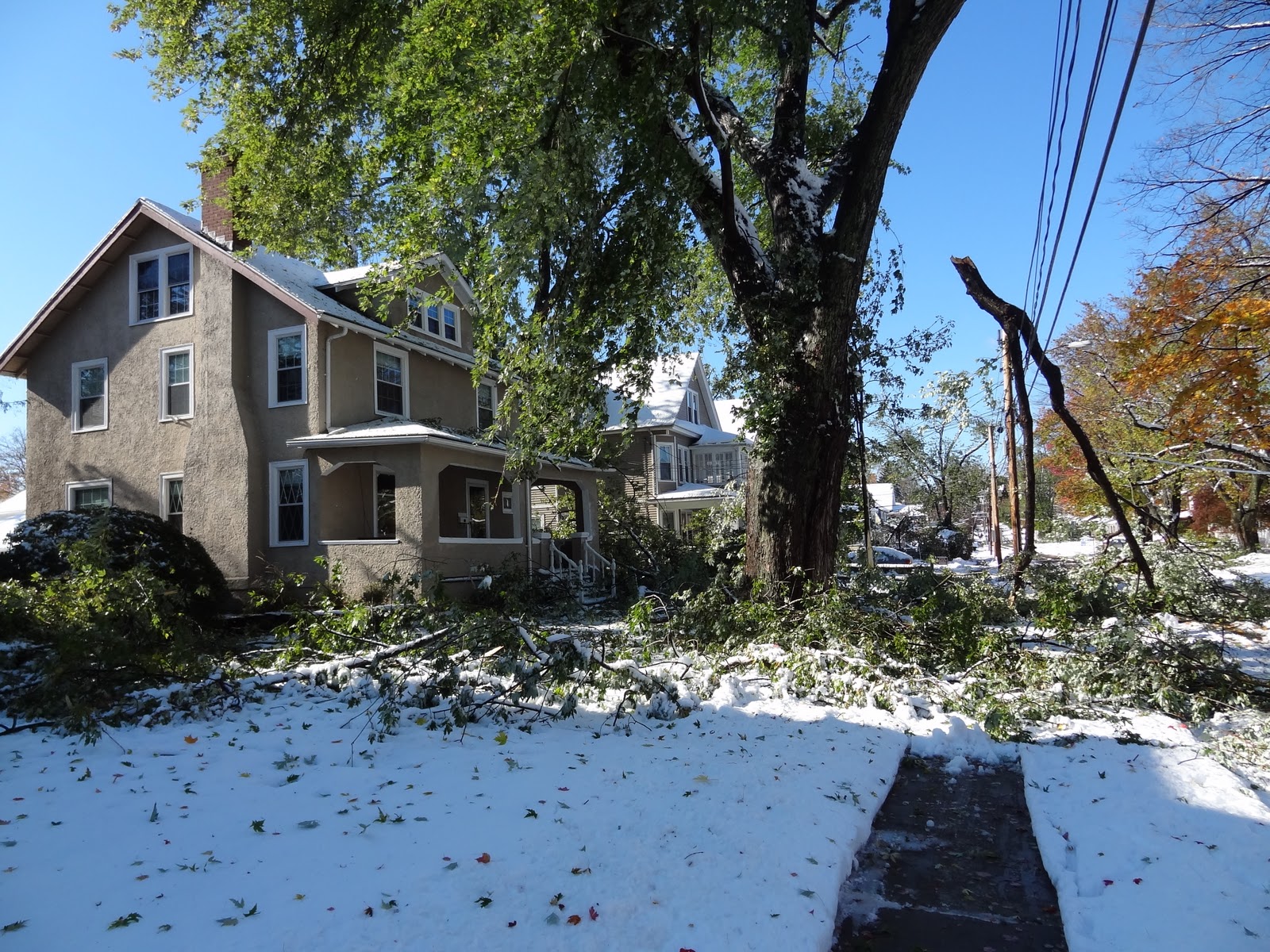
Like so many families in Connecticut, I found myself up most of last Saturday night into Sunday morning, held hostage by the periodic sounds of loud cracking followed by thunderous BOOMS as limb after limb crashed around my property. My family and I went 5 days without precious electricity and despite the loss of power, I had a ball. It wasn't all perfect by any means, but it wasn't terrible -not even close. I saw and got to be a part of many small and sizable gestures of kindness. I also got to experience a new form of reading.

But first, a small side-trek into how our family got through the storm and its aftermath.

Somewhere under the greenery and limbs is my home.
There was something very pleasing, to this guy at least, with having to confront the moment at hand and not worry about work schedules, traffic, the kids' soccer games, and other modern obligations. Without power, we had to scramble for heat, lighting, and preservation of food. We packed items in coolers using the snow, relied on a Napoleon stove and our fireplace for heating and cooking, and used a mish-mosh of candles and rechargeable lanterns for lighting. I love challenges like these. We lost very little food and managed to eat some great meals cooked by grill, heating stove, and fireplace during the week. We're still talking about the potatoes baked in the coals of the fire Our family of five, spent nights on the main floor tending to things, staying warm, and mostly getting along. We even told spooky stories on Halloween. 

It took 3 days to clear all the debris about the house and this happened with the help of our kindly, chainsaw-wielding neighbors. (In my dreams, the neighbors usually chase me with these, but this past week they seemed content focusing their attacks on the downed limbs.) My family and I returned the favor to others when we could and most days flew by as each task needing doing got done.

Survival moments aside, there were opportunities to read and see books, because part of most days were spent walking to Barnes and Noble in town. The primary goal was to recharge our electrical items. The second goal soon became one of sharing stories with neighbors and friends, who happened into the store for similar reasons. When those two missions were finished I was freed to explore books. Trapped in a bookstore for a week? That's the stuff of dreams for a reading teacher! While I perused many books, one experience really floored me.

We'd dragged our laptops, iTouches, Kindles, and iPad to the store planning to take advantage of the free Wi-Fi. At one point, when I was tired of roaming and chatting I decided to see what free reading materials I could pull down onto our iPad. I've loved stories told with pictures since I was a child and soon found myself exploring a site that offers loads of free comics. The comics on this site are specifically fitted to an iPad window and look great.

Zeroed in on one part of a full panel.
Now, if all the website/app did was display hi-resolution images of individual comic pages, I'd still enjoy it but would hardly have felt compelled to share the experience. Where things changed for me was when it was suggested by the app that I double-tap an individual frame on the comic book page. 

Doing this proved eye-opening. 

I sat stunned as the rest of the page disappeared and -like a camera zeroing in on one face in a crowd- the single panel of art and words became the focus. Incredible! 

I can sometimes turn to skimming when I read a lot in one sitting. Comic books are especially easy to do this with. I focus on the words but use the images to skip along at points. This new format of delivery the story stopped all that, instantly. I was memorized and spent extra time and attention on the word flow and artwork. I should probably add that it made me feel like a kid again.
a less dynamic full page of art and story

It's difficult to explain, in print, how dramatic an effect this had on reading the story. The best I can offer as comparison is to think of any news/magazine or documentary show on TV you've watched where still photos are shown very close to the screen and a camera pans slowly to different parts of it as narration unfolds. That was how this went on the iPad each time I read, then tapped, a panel. And, the camera movement wasn't always simply from one panel to the next. Sometimes the top of a large panel was the focus then -tap- the bottom of the same panel was panned to. Or, a small section of a character's face would be the lone focus before panning back to reveal the entire face and body. In one instance, the speed at which the panning happened was accelerated to underscore the moment a punch landed. 

So, for this slightly daft Nutmegger- the Great Pumpkin Storm was one I'll look back at fondly.

If you own an iPad, and are even vaguely interested in experiencing this reading approach for yourself, then head over to ComiXology, download the app, and explore some free comics.